The Hidden Cost of Grocery Shopping: What Are You Really Paying For?
The Hidden Cost of Grocery Shopping: What Are You Really Paying For?
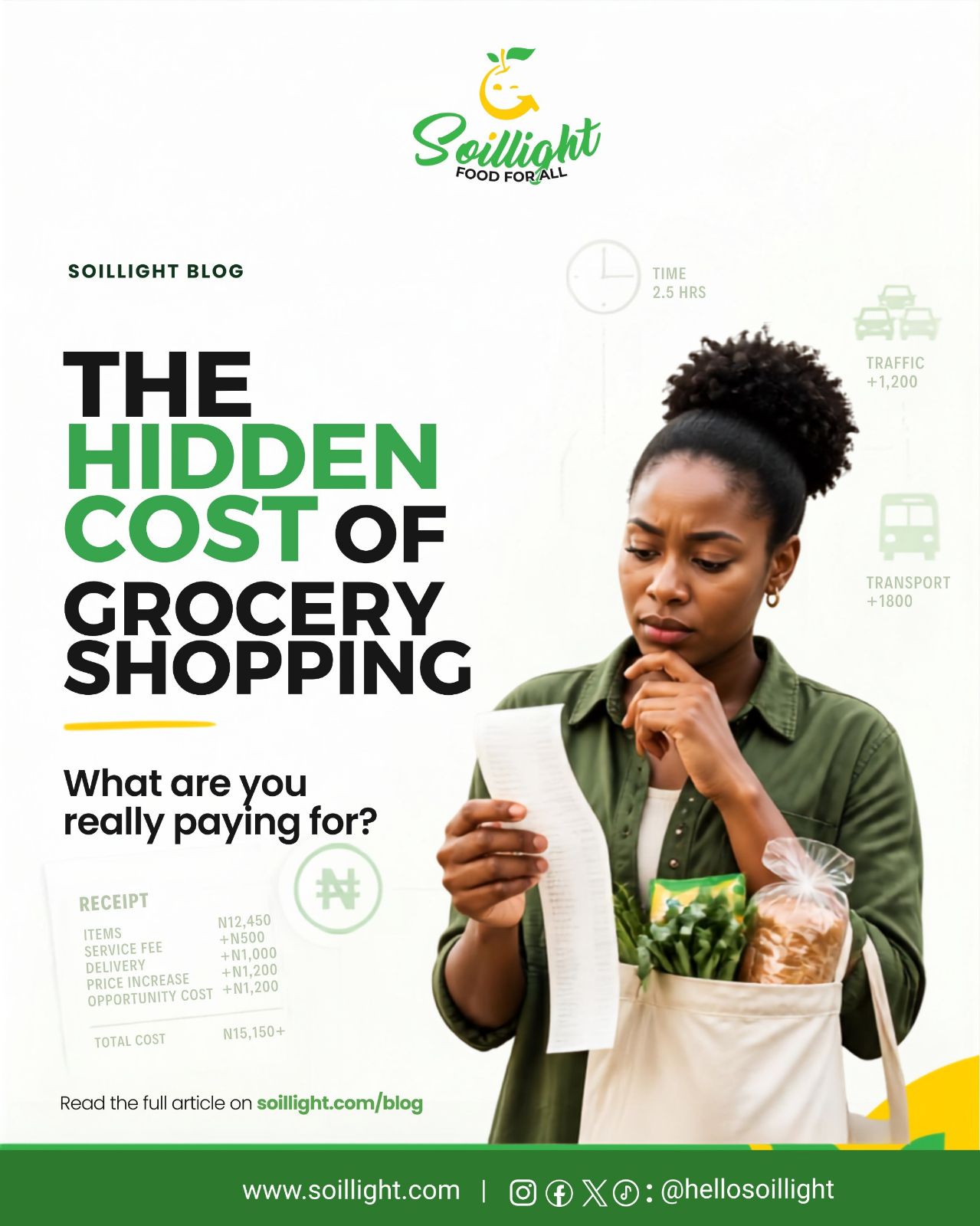
Ask someone how much they spent on groceries this week, and they'll usually give you a number that only covers what's in the bag. What it almost never includes is everything it took to get that bag home from Ketu, Mile 12, or Bodija.
That's the part nobody puts on a receipt and it might be the most expensive part of the whole trip. It's also exactly the gap platforms like Soillight are built to close, by bringing trusted market sellers to you at prices close to what you'd pay in person.
The costs that don't show up on the receipt
- Transport.
Bus fare, fuel, parking fees, or paying for an okada when traffic locks up the road to Oyingbo; getting to and from the market isn't free. A Danne Institute survey found public transport users spend an average of roughly ₦359 a day, or close to ₦1,800 a week, just navigating traffic to run errands like this.
- Time.
Time has a price, even when nobody's paying you directly for it. Two or three hours spent walking through Mile 12 or Wuse Market on a Saturday is two or three hours not spent resting, working a side hustle, or being with family. With Lagos commuters losing close to 30 hours a week to traffic on average, the "free" market trip starts looking very expensive.
- Traffic and stress.
Anyone who has tried to leave Mile 12 at midday knows this cost intimately. It's not just anecdotal — a Nigerian Institute of Transport Technology study found that over 70% of Lagos commuters report high stress levels linked directly to traffic congestion. That stress bleeds into decision-making, patience, and even the impulse purchases people make just to get out faster.
- Impulse spending.
Markets are designed, whether intentionally or not, to keep you looking. More stalls seen means more things bought that weren't on the list. That "small extra" adds up fast, and it's rarely accounted for in anyone's grocery budget.
- Opportunity cost.
This is the quiet one. Every hour spent shopping is an hour not spent doing something else with value — rest, income-generating work, or time with people who matter. It doesn't show up in Naira, but it's real.
Why this matters
When people compare "market shopping" to "ordering online," they usually compare only the price of the items and market prices often win that narrow comparison. But that's an incomplete picture. Once you add transport, time, stress, and impulse spend, the real cost of a grocery run looks very different from the number on the receipt.
This isn't an argument that the market is a bad deal. It's an argument that Nigerians deserve to see the full cost of their choices and to have an option, like ordering through Soillight or spreading a larger shop over time with Buy Now, Pay Later, that lets them keep the market's prices without absorbing every one of its hidden costs.
The real question
The next time you tally up a grocery run, it's worth asking: what did this actually cost me in Naira, in time, and in energy? Because the cheapest bag of tomatoes isn't always the cheapest trip.
What's the hidden cost you feel the most — the traffic, the time, or the impulse buys?
Curious how much a market run really costs you? See how Soillight prices compare without the transport, the traffic, or the time.
Comments (0)
No comments yet.