Why More Nigerians Are Switching to Online Grocery Shopping
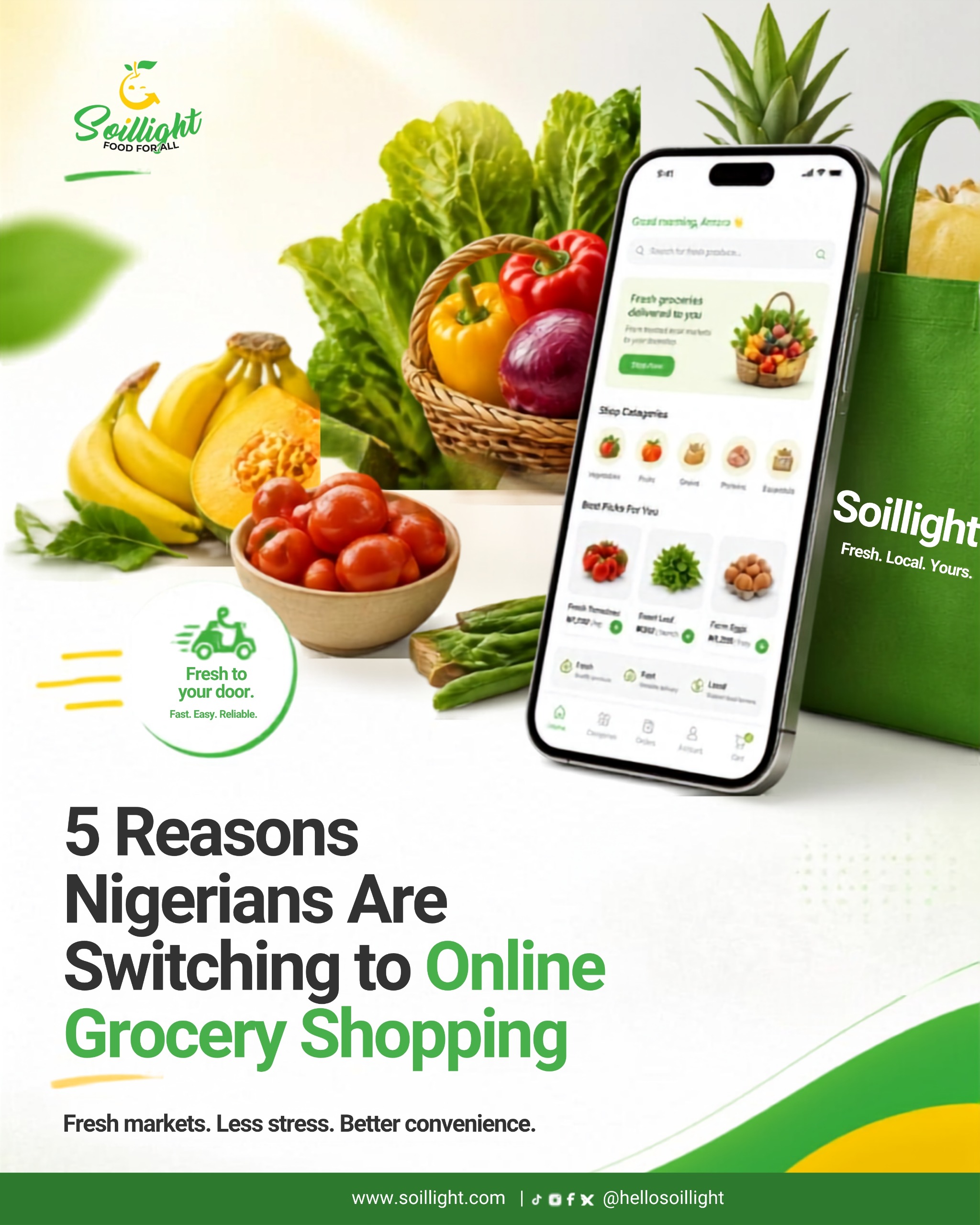
Grocery shopping in Nigeria has always meant early mornings, crowded stalls, and hours spent haggling for fresh produce. But that's changing fast. Across Lagos, Abuja, Port Harcourt, and beyond, more Nigerians are choosing online grocery shopping over the traditional market trip — and the data shows this shift is only accelerating. This article breaks down exactly why online grocery shopping in Nigeria is growing so quickly, what's driving the trend, and how platforms like Soillight are making the switch easier without cutting local market sellers out of the picture.
The Numbers Behind Nigeria's Online Grocery Shopping Boom
Nigeria's e-commerce market was valued at roughly $10.49 billion in 2026 and is forecast to reach $18.68 billion by 2031, growing at a compound annual rate of over 12% — one of the fastest growth rates in Africa. Mobile commerce already accounts for more than four out of every five online orders in the country, and smartphones alone made up over 82% of all e-commerce transactions in 2025. That mobile-first shift matters directly for groceries: ordering fresh produce, grains, meat, and household essentials from a phone is no longer a novelty — it's becoming the default for busy, connected Nigerian households.
1. Online Grocery Shopping Saves Time
Between work, family, and Lagos or Abuja traffic, few people have hours to spend navigating a busy market. Online grocery shopping lets you order fresh fruits, vegetables, grains, and household essentials in minutes, from wherever you are — no traffic, no queues, no wasted afternoons. For working professionals and parents juggling multiple responsibilities, this time saving is often the single biggest reason for the switch.
2. Access to Fresh, Quality Produce — Without the Market Trip
A common myth is that online groceries can't match market freshness. In reality, platforms like Soillight source directly from trusted local market sellers, meaning the same quality you'd hand-pick yourself — just delivered to your door instead. This matters more than most shoppers realize. Nigeria's post-harvest loss for fruits and vegetables is estimated at 50% or higher, according to the Nigerian Stored Products Research Institute (NSPRI), largely due to storage, handling, and transportation gaps between farm and final buyer. A tighter, more direct path from local seller to customer — the kind digital marketplaces enable — helps reduce the handling delays that cause spoilage in the first place.
3. Trusted Local Sellers, Not Anonymous Warehouses
Unlike faceless supermarket supply chains, Soillight connects customers directly with known market traders. You're not buying from a stranger — you're supporting the same sellers who have served Nigerian communities for years, now made accessible online.
4. Transparent Pricing Beats Market Haggling
Digital marketplaces make it easier to compare prices, spot deals, and avoid the price inflation that sometimes comes with haggling as a first-time or unfamiliar buyer. What you see is what you pay — a meaningful shift for shoppers who've historically paid a “newcomer premium” at unfamiliar stalls.
5. Every Order Supports Nigeria's Growing Digital Economy
Every online grocery order is part of a bigger shift — one where local commerce and technology work together rather than compete. By shopping online through platforms built around local sellers, customers help traditional traders grow their businesses beyond their physical stalls, strengthening local food supply chains in the process.
Is Online Grocery Shopping Safe and Reliable in Nigeria?
Safety and reliability are the two biggest hesitations for first-time online grocery shoppers in Nigeria — and reasonably so, given the market's historical reliance on cash-on-delivery and in-person trust. The good news: platforms that vet their sellers, publish ratings, and offer delivery tracking directly address both concerns. Rising digital wallet adoption, projected to reach 22% of transaction value by 2027, and improving agent networks are also steadily reducing Nigeria's historic trust gap with online payments.
What to Look for in a Grocery Delivery App in Nigeria
Not every online grocery platform is built the same way, and the difference shows up in freshness, reliability, and price. Before choosing where to shop, it's worth checking for a few specific things:
- Verified sellers — the platform should clearly vet who it lists, not just aggregate listings from anywhere.
- Transparent pricing — prices should be visible upfront, without hidden fees added at checkout.
- Delivery tracking — you should be able to see order status in real time, not just wait and hope.
- Flexible payment options — including cash on delivery for shoppers not yet comfortable paying online.
- Clear return or resolution policy — for the rare cases where an order doesn't meet expectations.
Platforms that check all five boxes tend to earn repeat customers quickly, because the biggest barrier to online grocery adoption in Nigeria has never been interest — it's trust. Solve for trust, and convenience takes care of the rest.
KEY TAKEAWAYS
1. Online Grocery Shopping Saves Time
Between work, family, and Lagos or Abuja traffic, few people have hours to spend navigating a busy market. Online grocery shopping lets you order fresh fruits, vegetables, grains, and household essentials in minutes, from wherever you are — no traffic, no queues, no wasted afternoons. For working professionals and parents juggling multiple responsibilities, this time saving is often the single biggest reason for the switch.
2. Access to Fresh, Quality Produce — Without the Market Trip
A common myth is that online groceries can't match market freshness. In reality, platforms like Soillight source directly from trusted local market sellers, meaning the same quality you'd hand-pick yourself — just delivered to your door instead. This matters more than most shoppers realize. Nigeria's post-harvest loss for fruits and vegetables is estimated at 50% or higher, according to the Nigerian Stored Products Research Institute (NSPRI), largely due to storage, handling, and transportation gaps between farm and final buyer. A tighter, more direct path from local seller to customer — the kind digital marketplaces enable — helps reduce the handling delays that cause spoilage in the first place.
3. Trusted Local Sellers, Not Anonymous Warehouses
Unlike faceless supermarket supply chains, Soillight connects customers directly with known market traders. You're not buying from a stranger — you're supporting the same sellers who have served Nigerian communities for years, now made accessible online.
4. Transparent Pricing Beats Market Haggling
Digital marketplaces make it easier to compare prices, spot deals, and avoid the price inflation that sometimes comes with haggling as a first-time or unfamiliar buyer. What you see is what you pay — a meaningful shift for shoppers who've historically paid a “newcomer premium” at unfamiliar stalls.
5. Every Order Supports Nigeria's Growing Digital Economy
Every online grocery order is part of a bigger shift — one where local commerce and technology work together rather than compete. By shopping online through platforms built around local sellers, customers help traditional traders grow their businesses beyond their physical stalls, strengthening local food supply chains in the process.
Is Online Grocery Shopping Safe and Reliable in Nigeria?
Safety and reliability are the two biggest hesitations for first-time online grocery shoppers in Nigeria — and reasonably so, given the market's historical reliance on cash-on-delivery and in-person trust. The good news: platforms that vet their sellers, publish ratings, and offer delivery tracking directly address both concerns. Rising digital wallet adoption, projected to reach 22% of transaction value by 2027, and improving agent networks are also steadily reducing Nigeria's historic trust gap with online payments.
What to Look for in a Grocery Delivery App in Nigeria
Not every online grocery platform is built the same way, and the difference shows up in freshness, reliability, and price. Before choosing where to shop, it's worth checking for a few specific things:
- Verified sellers — the platform should clearly vet who it lists, not just aggregate listings from anywhere.
- Transparent pricing — prices should be visible upfront, without hidden fees added at checkout.
- Delivery tracking — you should be able to see order status in real time, not just wait and hope.
- Flexible payment options — including cash on delivery for shoppers not yet comfortable paying online.
- Clear return or resolution policy — for the rare cases where an order doesn't meet expectations.
Platforms that check all five boxes tend to earn repeat customers quickly, because the biggest barrier to online grocery adoption in Nigeria has never been interest — it's trust. Solve for trust, and convenience takes care of the rest.
- Nigeria's e-commerce market is growing at over 12% annually, with mobile devices driving more than 80% of online orders.
- Online grocery shopping saves time by removing the need for market travel, queues, and haggling.
- Platforms sourcing from verified local sellers can match — and in some cases improve — freshness compared to informal supply chains.
- Nigeria loses an estimated 50%+ of fruits and vegetables to post-harvest spoilage; more direct seller-to-customer paths help reduce this.
- Transparent, fixed pricing removes the guesswork and “newcomer premium” common in physical markets.
- Every order placed through a local-seller marketplace like Soillight supports Nigeria's traditional traders, not just its digital economy.
FREQUENTLY ASKED QUESTIONS
Is online grocery shopping safe in Nigeria?
Yes. Platforms like Soillight work with verified local market sellers and provide delivery tracking, making transactions secure and reliable.
Is online grocery shopping cheaper than the market? Prices are typically comparable to market rates, with the added benefit of transparent pricing and no haggling required.
What can I buy on Soillight?
Fresh fruits, vegetables, grains, meat, seafood, and everyday household essentials — sourced from trusted local market sellers.
How fast is delivery for online grocery orders in Nigeria?
Delivery windows vary by seller and location, but same-day and next-day delivery are increasingly standard for major cities like Lagos and Abuja.
Do I need to pay online, or can I pay on delivery?
Most platforms, including Soillight, support multiple payment options, including cash on delivery, for shoppers who aren't yet comfortable paying online.
Will online grocery shopping replace Nigeria's markets?
No — it extends them. Digital platforms give local sellers a wider reach while physical markets continue to serve their communities directly.
Can I order in bulk for a family or event?
Yes, most grocery marketplaces support bulk ordering, and some sellers offer better per-unit pricing for larger orders.
Comments (0)
No comments yet.